How Music Keeps Kids School-Ready

What no one tells families about back-to-school time is that routines, connectedness, and self-regulation aren’t guaranteed to fall into place by the end of the first few weeks.

So, what happens when daily meltdowns, anxiety, problems in the classroom, and general behavior issues at school and home are still occurring?

We need another “adjustment” solution.

That’s where the combination of musical play and behavior-decoding tools comes in.

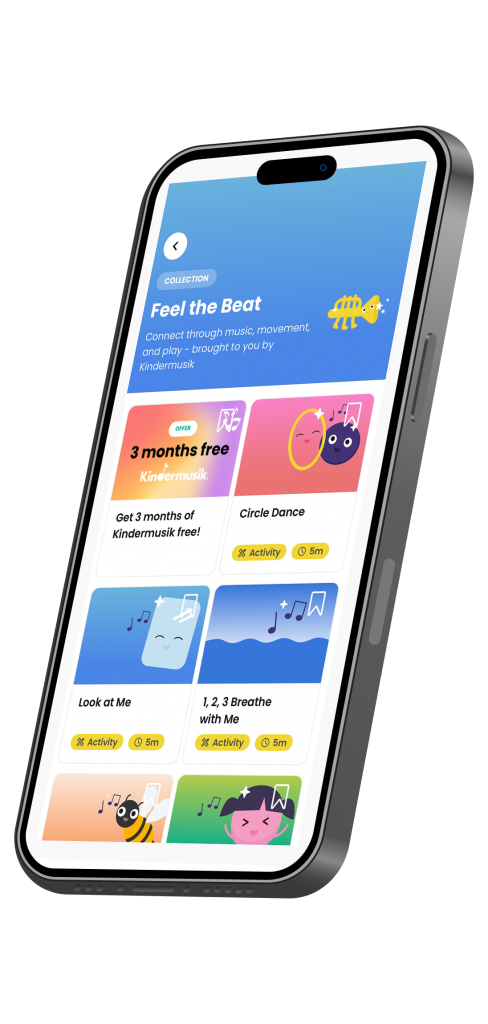
Kindermusik partnered with HeyKiddo—a research-driven app, designed by psychologists for parents, teachers, and early intervention specialists—to create a collection of musical activities that helps instill safety, communication, and excitement for school all year long.

Here’s the science behind it, what’s inside, and how you can access the collection and corresponding coloring sheet for FREE.
What science says about music and emotional school readiness

Talk to any early education professional—school readiness is as much or more about emotional regulation and communication skills as it is about academic development.

Those things are what support academic development, and if they’re not in place, children are not set up for success.

A study from West Chester University examined behavior across 191 3-5-year olds, and found that those who received music intervention (in a shared music-making approach) showed greater inhibitory control.

Why?

  • Stress levels in the body decrease
  • Oxytocin and other happy chemicals increase
  • Heartbeats (as you move or play to the beat) align brainwaves between participants

All of this supports cooperation and an eagerness to learn.

The problem with turning to music as a behavioral intervention is that teachers and families often don’t have the guidance to get started. Kindermusik’s “Feel the Beat Collection” in the HeyKiddo app lays it out in simple steps.

Here’s how you can grab it for free.

Try these simple, engaging musical activities anywhere.

The beauty of the HeyKiddo approach is that it’s meant to be just as easy for the grownup to instigate as it is for the child to participate.

Grab a free 3-month trial of HeyKiddo to access the “Feel the Beat” collection and much more! Just tap this link from your smartphone to get started.

Get a sneak peek.
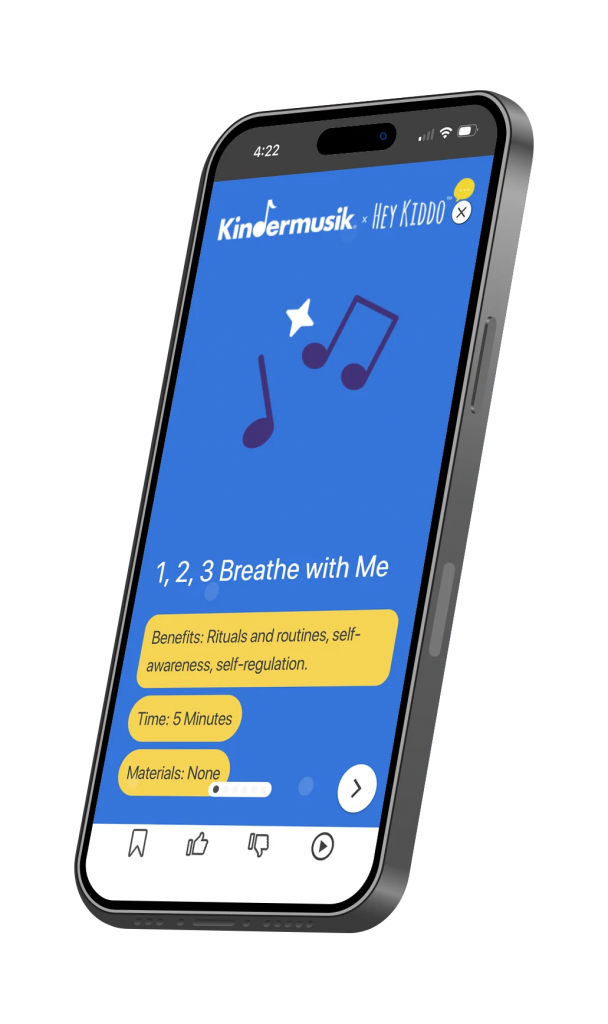
We love “1, 2, 3 Breathe with Me” as a starting point for re-setting during tough moments or just prepping minds and bodies for the day ahead. Play the track below and follow along with your little one or students.

“1, 2, 3 Breathe with Me” from the Kindermusik x Hey Kiddo “Feel the Beat” Collection

Download a free back-to-school coloring sheet!
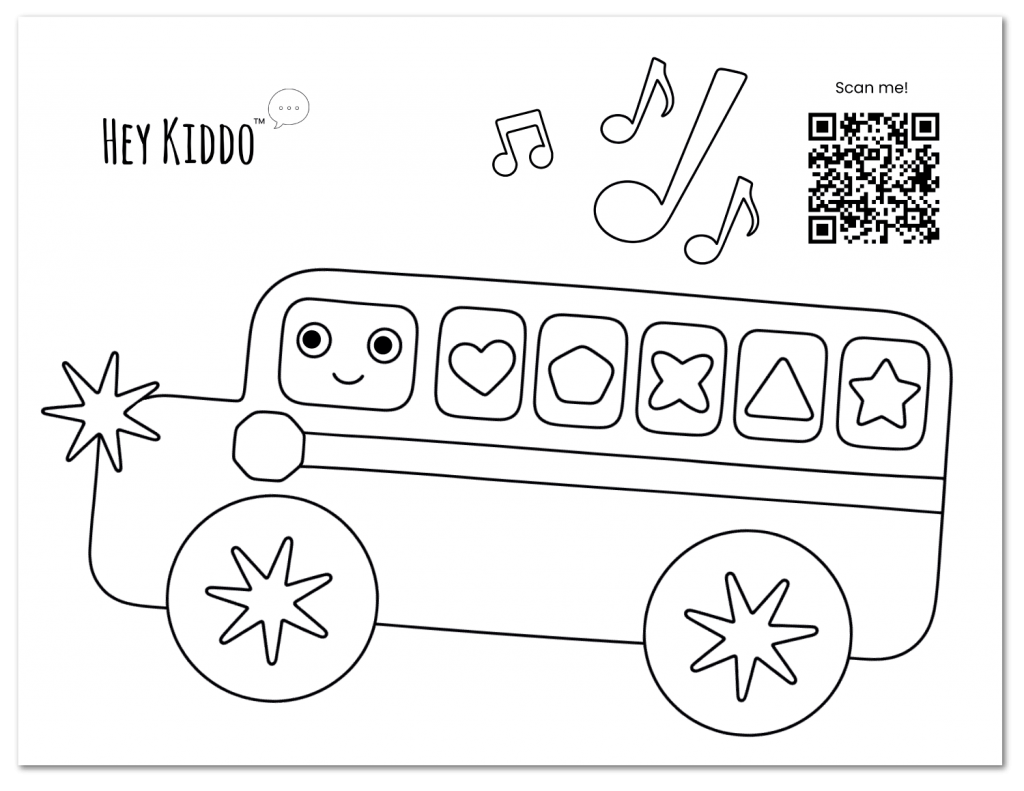
Drawing and music go hand-in-hand. Turn on some calming music from the collection and get out the crayons for this bonus activity.

Take it one step at a time.

No matter how much you prep for childcare or school, new environments, new people, and new rules are so much more stressful for little ones.

Adding in a musical play break here and there can make all the difference—just be patient with yourself and the child(ren). Readiness, for anything, takes time and intention.

To get the Feel the Beat musical activity collection, sign up for a free trial of HeyKiddo here. For more musical teaching tools, check out these Kindermusik solutions. And to find a studio class near you, search here.

School Readiness Begins at Birth

9-month-old baby engages in scarf play with mom during a Kindermusik class designed to support early school readiness.

School readiness for babies? Sounds a little extreme, but did you know an infant’s brain doubles in size during the first year? This window of learning opens wide in those first 12 months, and the easiest way to boost school readiness is to amplify bonding moments, joyful age-appropriate play, and rich multisensory activities that support those critical brain leaps. 

Shared musical play is the perfect tool.

Continue reading “School Readiness Begins at Birth”

5 musical learning activities that teach school readiness skills

Music class drumDid you know that the benefits of music include preparing a child for school? When intentionally used as part of a pre-K curriculum or preschool curriculum, musical learning can positively impact the cognitive development in children and help children of all abilities be ready to learn at any age. Here are just five ways to use music when teaching children enrolled in a preschool or pre-K curriculum.

5 musical learning activities that support cognitive development in children

  1. Circle dances teach cooperation. Ringing around the rosey gives children more than a pocketful of posies. Choreographed movements require children to cooperate, move in synch with a group, and listen to and follow oral instructions.
  2. Identifying the specific sounds (or timbre) of different instruments teaches children auditory discrimination. The same sound discrimination used in recognizing the difference between the musical note “C” played on a clarinet verses the same note played on a piano by sound—not sight—helps children hear the minute differences between letter sounds or phonemes, which supports early literacy and language development.
  3. Moving to the tempo of the music teaches children to be active listeners. When children respond to the changing tempo of a song—from fast to slow—or when children move slowly when they hear the music change from staccato to legato, they are using their body movements to practice active listening skills.
  4. “Stop and Go” activities with music builds self-regulation skills. Children need to learn to tell their bodies what to do, when to stop, when to go, and when to move on to another activity. When playing a musical learning game of “Freeze Dance,” children learn and practice self-regulation skills by responding to the musical cues.
  5. Finger plays, such as “Itsy-Bitsy Spider,” help children learn to coordinate hand, finger, and wrist movements that support fine motor control and precision. Those fine motor skills will help children hold a pencil correctly, use scissors, and even tie their own shoes.

Pre-K curriculum uses musical learning

Early Literacy gains with ABC Music & Me
Our school partners and students benefit from ABC Music & Me – see the research-proven results!

In our preschool curriculum, ABC Music & Me, teaching children includes singing, dancing, and instrument exploration. Throughout all the musical learning, teachers are laying the groundwork for school readiness. Plus, our preschool curriculum includes proven results, in spatial-temporal reasoning, self-control, and even a 32 percent gain in early literacy.

For more information about bringing our pre-k curriculum, preschool curriculum, or Head Start curriculum to your school, email us at info@abcmusicandme.com.

How Music Classes Prepare Your Child for School

Early childhood education is important, and Kindermusik International believes that you – the parent – are your child’s first and best teacher.  But what to do with your child until he is 7 years old?  We’d like to recommend Kindermusik classes!

9 ways Music Classes prepare your child for school

teaching children in Kindermusik - mom and sonMusic classes in the early years that include parental involvement and focus on learning in a fun, developmentally appropriate way inspire a lifelong love for learning.
Practice with steady beat, enjoying movement activities, and playing instruments help develop coordination and motor skills necessary for cutting with scissors, holding a pencil, or kicking a ball, for example.
Music classes that are teaching children rhymes and then later, the basics of beginning to read music pave the way to literacy.
Music classes give your child a place to practice those all-important social skills, like cooperatively play, sharing, and following directions.
The best music classes will encourage your child to think creatively, developing critical thinking skills and the ability to problem-solve.
In an environment where process, not performance, is stressed, music classes build self-confidence and a willingness to try new things.
Music classes that gradually increase a child’s independence at the class help the child more successfully transition to the school classroom.
In these classes, children have the opportunity to bond and interact with their teacher, learning to listen and respond to someone other than the special adults who surround them at home.
Science and research have proven time and time again that music positively impacts a child in all areas of development – social/emotional, language, cognitive, physical, and language/literacy.

Kindermusik Classes - Enroll Now - For a Child's Brain, Body, Heart & SoulFrom music skills to life skills, it’s all there in Kindermusik, where music and learning play!  Find a class near you and try a free Kindermusik class on us today.

 
Written by Theresa Case, whose Kindermusik program at Piano Central Studios in Greenville, SC, is proudly among the top 1% of Kindermusik programs worldwide.